Rebuilding an inclusive city: my meeting with pope Leo XIV and the fight against the new Babel
di Mark Ruffalo
The American actor writes a letter to Avvenire in which he reflects on the encyclical Magnifica Humanitas (english version)

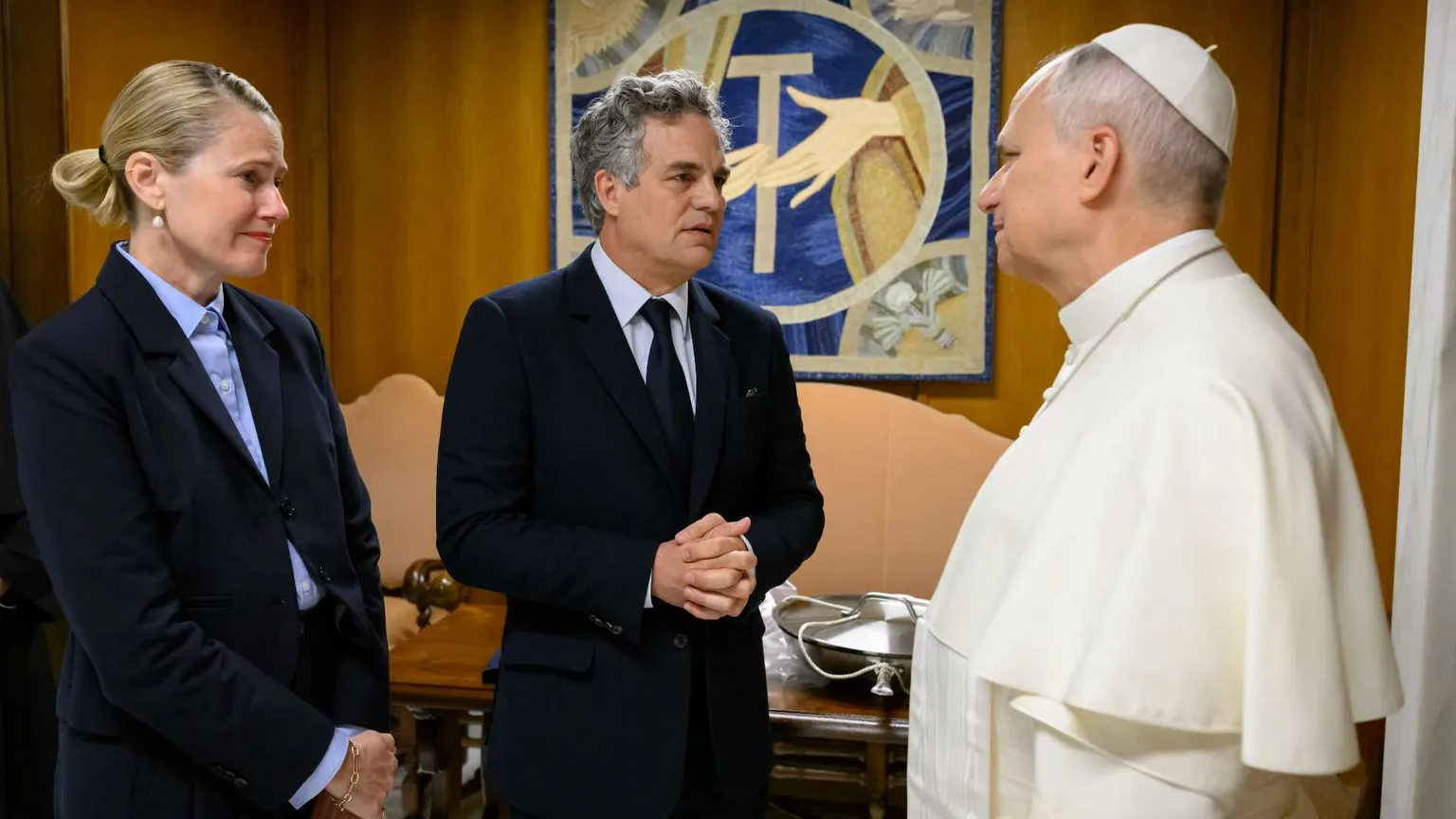
I had the profound privilege of meeting Pope Leo XIV and was struck by his moral clarity and strength. In the audience hall, I found myself before the first American Pope, who radiated an innate gentleness and displayed his calm disposition. My partner Sunny and I initially asked him to pray for a loved one suffering from a serious illness. He listened to us with deep compassion. Seeing the Pope look you in the eye and promise to pray for someone you love is incredibly moving. I also thanked him for his intervention in favor of the humanitarian mission of the Global Sumud Flotilla. When organizers Saif Abukeshek and Thiago Avila were illegally intercepted, imprisoned, and mistreated in their attempt to bring aid to the suffering Palestinian people, the Pope's intervention helped secure their release.
I stood before him as both an artist and an activist, bringing with me the struggles that many of us have been fighting for years. Our conversation, in line with his new, historic encyclical, Magnifica Humanitas, laid bare the crucial challenge of our time: community versus colonialism, "power with" versus "power over."
Two gifts against the idols of modernity
For the occasion, I brought His Holiness two gifts that represent a lifetime of work. The first, a universal symbol for filmmakers: a production clapboard from the movie I just wrapped. He seemed genuinely delighted by it. The second was a non-stick frying pan free of PFAS, the notorious "forever chemicals". I had heard that Pope Leo loves to cook. This gift was a way to ensure he could cook safely, but also shone a spotlight on this issue. Since I filmed Dark Waters years ago, the regulation and remediation of these chemicals — linked to cancers and illnesses, and now present in the blood of every creature on Earth — have become a pillar of my activism. Protecting water from forever chemicals and oil and gas drilling led me to forge a deeply meaningful bond with Indigenous water protectors, including those at Standing Rock, who were threatened by an oil pipeline after generations of colonialism and dispossession. I raised the issue of the Church's responsibility in creating this mindset of colonial oppression. We spoke about the 15th-century Papal Bulls and the "Doctrine of Discovery," which is at the root of colonialism in the world, having provided the moral justification for the plundering of Indigenous lands, treating human beings as capital, and degrading their societies. Pope Francis rightly repudiated this doctrine in 2022, and the Vatican has made symbolic efforts to return sacred antiquities.
I asked Pope Leo to continue this vital healing process for our Native family in North America and beyond by returning the historical and religious objects still in the Vatican's possession. The Pope said he completely agreed and took responsibility on behalf of the Church. He also recognized that, although his predecessor started this path, there is still much to be done.
The algorithm as a new colonial weapon
A few days after our meeting, the Pontiff presented Magnifica Humanitas, billed as an encyclical on artificial intelligence, but which in reality demonstrates how profoundly Pope Leo grasps the colonial mindset underpinning today's systems of extraction, including AI. And, crucially, he apologizes for the Church's share of responsibility in shaping them. Magnifica Humanitas suggests that, to grasp the true nature of Silicon Valley, we must look not at a microchip, but at the old Atlantic ports from which enslaved people were shipped and brutalized, and at the dehumanizing violence of Europeans and Americans against Indigenous peoples. AI is not a sudden technological miracle, but rather the latest and sharpest weapon in an eternal campaign by the powerful to conquer, catalog, and diminish the human soul and the natural environment.
The Pope condemns what he calls the "Babel syndrome," the technocrats' dream of power and control that would reduce the infinite mystery of human life to an algorithm, optimized for performance metrics and corporate profit. The biblical story of Nehemiah—an exile who returns to his ruined city, organizing families and the community to rebuild it—stands in stark contrast to this syndrome. On one hand, the hubristic concentration of power and hoarded resources; on the other, power distributed through community organizing: this is the central choice the encyclical sets before us.
AI did not fall from the sky like a rogue meteorite to disrupt an otherwise peaceful civilization. It is a mirror reflecting our darkest historical vices. Algorithms optimize injustice; they do not invent it. AI is perfectly consistent with those who promote profit-making and systematic exploitation of the most vulnerable.
As an artist, I am particularly sensitive to the fact that the collective intellectual product of millions of people — entire lifetimes of creative work, writing, thought, and philosophy deposited online as a resource for all humanity — is being plundered and plagiarized without consent. AI seeks to extract humanity's collective genius, lock it away in corporate code, and sell it back to us at a premium, building walls instead of bridges to knowledge. Pope Leo rightly presents this process as a colonial model of plunder applied directly to the human mind, designed to steal jobs and replace us with a soulless version of ourselves. All of this to concentrate wealth and power in fewer and fewer hands. The chaos of this new Babel is not just digital; it is violently physical. Maintaining the enormous computing power required by this AI "revolution," tech barons, fossil fuel lords, and war profiteers have forged a devastating alliance, turning our commons into an environmental dumping ground.
Millions of liters of fresh water, an increasingly scarce resource, are wasted every day just to cool the servers of a wealthy few. Data centers worldwide are projected to consume more energy than many nations combined, fueling an insatiable demand for energy that translates, under our current politics, into a massive demand for fossil fuels that pushes us closer to climate catastrophe. The rush for gas has ravaged communities worldwide, including those in Texas and Louisiana, where already polluted populations now suffer health-threatening gas extraction.
Italy, following the ban on Russian gas, has promised to buy Trump's gas, by funding its system of destruction just when it should turn its back on all of these corrupt authoritarians. Trump’s drive toward "energy dominance," his wild race for oil and gas, as opposed to renewable energy, which is sound, stable, cost-effective, and environmentally friendly, feeds a frantic militarism, shattering historic alliances and causing catastrophic bloodshed. Why should Italy support this dictatorship against its own interests, when renewable energy is cheaper and promotes peace? At the Pope’s side, I could feel the sand draining out of the hourglass. There was still so much I wanted to discuss. I wanted to talk about achieving true justice and reparations for survivors of clergy sexual abuse. I wanted to talk about women's health, reproductive rights, and full equality within Church structures.
But as I looked at him, I chose to evoke the Magnificat of the Virgin Mary: «He has brought down the powerful from their thrones, and lifted up the lowly». Pope Leo nodded gently and jokingly reminded me that there were 40,000 people waiting for him in St. Peter's Square. We laughed, and I left filled with immense gratitude for an authentic messenger whose heart is sincerely dedicated to human dignity.
A shared agenda for action
The Pope's message is giving courage to people, believers and non-believers alike. Hope is not a passive state, but a mandate for collective action. In the encyclical, the Pope points us to the biblical figure of Nehemiah, who returned to a ruined Jerusalem. He did not try to save it alone: he organized the community, divided the labor, and together they rebuilt the walls of a cohesive city. If we want to fight the new forms of colonialism — whether they come from fossil fuel companies, Silicon Valley, dictators, or all of them joined in a conspiracy — we must act like Nehemiah's builders. And we must reject the chaotic Tower of Babel that raises walls around a wealthy few and leaves everyone else out. We must build a city together that promotes equal opportunities and respect for human dignity and the environment.
Either we fight this mass dehumanization now, or we will fight it when our very survival is at stake. Following the path traced by Magnifica Humanitas and, before that, Laudato si', we can divide the labor
- Organize at the local level: We can organize locally to reject AI extractivism and defend the uniqueness of human creativity. We can support unions, writers' guilds, and creators fighting against AI plagiarism, treating human thought, art, and philosophy as a sacred treasure that cannot be colonized or resold. We must make our voices heard, protest, and sever ties with political forces and corporate boards pushing us toward AI-assisted surveillance and warfareb
- Choose peace and reject occupation in all its forms: Reject the logic of energy wars and occupation. Challenge development models based on fossil fuel extraction that, through the market and resource dominance, create poverty, instability, and pollution. Work, therefore, to dismantle speculative fossil fuel and gas deals — like those being imposed across Europe — and demand an immediate and binding shift toward renewable energy in the name of health, climate, and peace. Stand firmly in solidarity and offer hospitality to those affected by pollution and those forced to flee due to climate collapse and wars fueled by fossil fuels and a dystopian AI.
Breaking our movements down into manageable goals does not mean fragmenting our purpose. Like Nehemiah's builders, we are constructing a united, collective power to live independent and free from dictators and colonizers. ‘People need the Church, and people need one another. Let us stop enriching the billionaires building machines of surveillance and death. Let us open ourselves up again to our shared world and build a city that belongs to us all.
Italian version: Mark Ruffalo: «Il mio incontro con papa Leone XIV e la lotta contro la nuova Babele»
Italian version: Mark Ruffalo: «Il mio incontro con papa Leone XIV e la lotta contro la nuova Babele»
© RIPRODUZIONE RISERVATA
 Seguici anche su Google Discover di Avvenire